Mental illness has long been shaped—and often distorted—by political power. For the RUOK blog, we can trace how systems of control have defined, stigmatized, and weaponized mental health, while positioning RUOK as a movement for dignity, clarity, and collective care.
Power, Politics, and Mental Illness: A Historical Lens
Throughout history, mental illness has been deeply entangled with political authority. From institutionalization to public policy, those in power have often dictated not just how mental health is treated—but how it’s perceived.
- 19th–20th century asylum systems: Governments built sprawling psychiatric institutions not just for care, but for containment. These spaces often reflected societal fears more than medical understanding, reinforcing stigma and social exclusion.
- Cold War and political psychiatry: In the Soviet Union, dissenters were labeled mentally ill and forcibly treated—weaponizing psychiatry to suppress opposition. This abuse of diagnostic power shows how mental illness can be politicized to silence and control.
- Modern partisan divides: Recent studies reveal that political polarization correlates with worsening mental health. High-functioning depression, anxiety, and burnout are exacerbated by constant political stressors—especially in marginalized communities.
- Mental health as a political determinant: Structural inequities—housing, education, criminal justice—are shaped by policy, and in turn, shape mental health outcomes. Daniel Dawes calls these the political determinants of health, urging us to see mental illness not just as a personal struggle, but a systemic consequence.
RUOK as a Counterforce to Political Erosion
RUOK enters this landscape not as a partisan voice, but as a protective, inclusive movement—one that refuses to let mental illness be distorted by power or buried in silence.
- Fractured typography and elongated tie: These visual elements symbolize the tension between public identity and private strain. They evoke the emotional toll of political systems that fracture our sense of self.
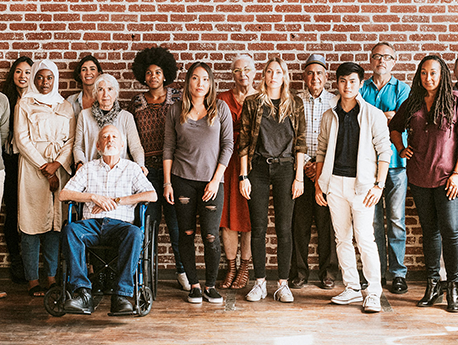
- Universal silhouettes: By featuring youth, elders, and anonymous crowds, RUOK resists the politicization of mental illness. It centers care, not control.
- Call to action: The historical misuse of psychiatry shows us how fragile dignity can be when mental illness is politicized. RUOK is a refusal to let that history repeat itself. It is a movement for clarity, collective healing, and universal care—anchored in design that makes visible both the fractures and the hope for repair.
- RUOK doesn’t just ask “Are you okay?”—it demands that we build systems where that question can be safely answered Power, Politics, and Mental Illness: A Historical Relationship
- Asylums and social control (19th–20th century)
Large psychiatric institutions were often less about care and more about containment. Governments used them to manage populations deemed “unfit,” reinforcing stigma and exclusion. - Political psychiatry in the Soviet Union
During the Cold War, dissenters were diagnosed with “sluggish schizophrenia” and confined to psychiatric hospitals. This weaponization of psychiatry turned mental illness into a political tool for silencing opposition. - Civil rights and deinstitutionalization (1960s–1980s)
Activists challenged the abuse of psychiatric power, leading to deinstitutionalization. Yet without adequate community support, many people with mental illness were left vulnerable, showing how political decisions directly shape outcomes. - Contemporary polarization and stress
Research shows that political polarization and instability exacerbate anxiety, depression, and burnout. Mental health is not just personal—it’s systemic, shaped by policy and power structures.
Blog Direction Idea
Power and Psychiatry – How governments have historically defined and controlled mental illness
Political Stress and Burnout – The toll of polarization on emotional well-being
RUOK as Resistance – How visual design and messaging reclaim mental health from political distortion
Policy and Prevention – What trauma-informed, inclusive systems could look like in practice
Sources:
https://www.psychologytoday.com/us/basics/depression